

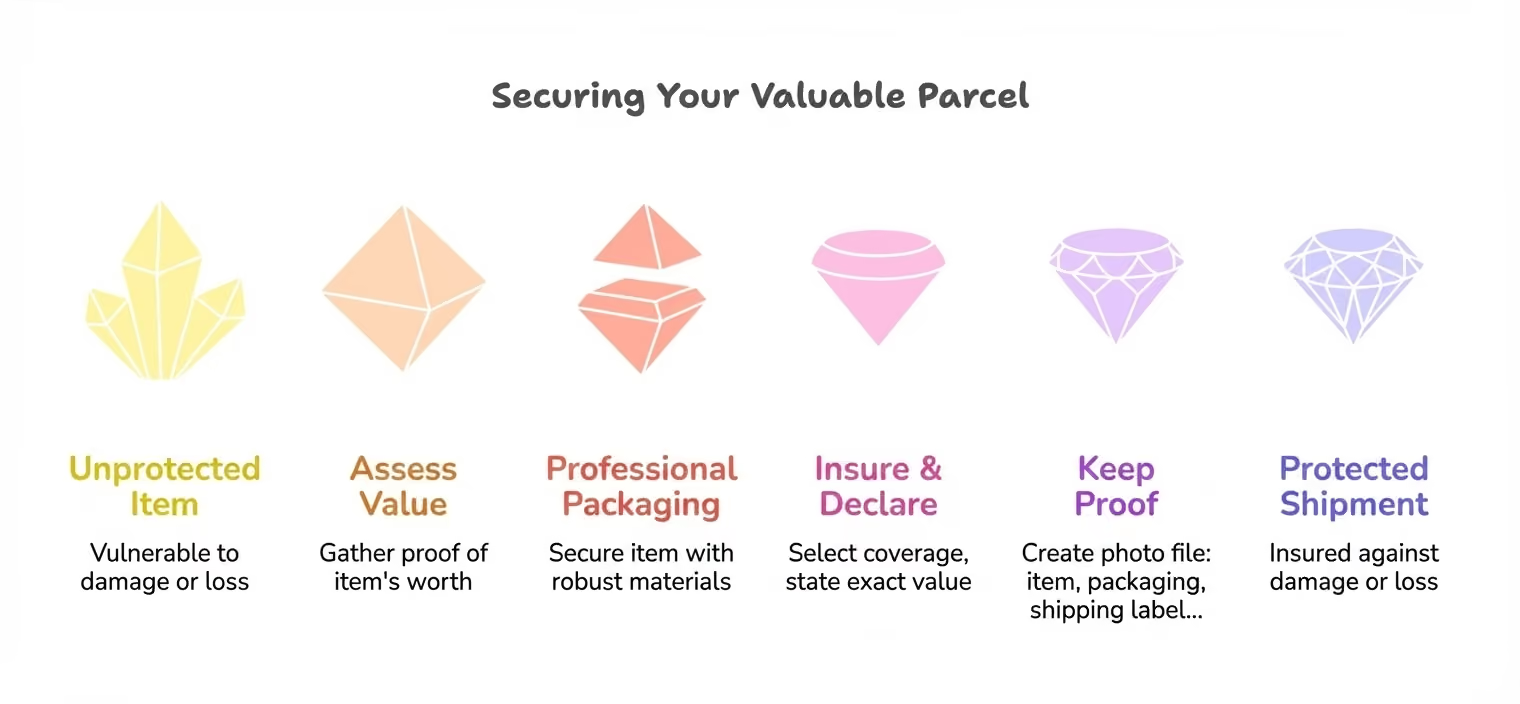
For a business that ships goods worth more than €2,000, high-value parcel insurance isn't just a nice-to-have: it's the only way to be compensated for the actual value in the event of loss, theft, or damage. The coverage provided by carriers compensates based on weight, not value, leaving a significant gap for valuable items.
The context highlights the magnitude of the issue. According to a DS Smith study conducted by the Opinium Institute among 2,000 consumers in October 2025, damaged parcels cost French retailers 2.3 billion euros in 2025; 22% of French people report having received at least one damaged item in the past twelve months, and 60% would stop buying from a retailer after several defective deliveries. This study focuses on damage in general, with tableware and glassware being the most vulnerable items. For high-value items, the issue is not the frequency—which is lower—but the magnitude of the loss per incident, combined with very low carrier liability limits.
This guide, intended for professionals, explains why basic insurance is a trap for valuable items, what ad valorem insurance really is, how the various solutions on the market compare, how to choose the right option based on your business, how to set up coverage, and what mistakes to avoid.
Why Basic Shipping Insurance Is a Trap for Valuables
The carrier’s liability is a legal obligation, but it is capped based on the weight of the goods, unless a declared value, special agreement, or specific regime applies. In international road transport, the CMR Convention limits compensation to 8.33 SDRs per kilogram of gross weight missing, or approximately 10 euros per kilogram; for air transport, the Montreal Convention has set the limit at 26 SDRs per kilogram since December 28, 2024. The SDR is a floating-rate unit of account used by the International Monetary Fund, so these euro equivalents are for informational purposes only.
The decisive factor is the value-to-weight ratio. The more expensive an item is relative to its weight, the further the compensation per unit of weight deviates from its actual value.
These amounts are intended to illustrate the order of magnitude, subject to the SDR exchange rate, the applicable policy, and the circumstances of the loss. The conclusion remains the same: for a valuable item, statutory compensation covers only a negligible fraction of the loss. The overall mechanism is detailed in our guide to cargo insurance.
Key Figures for 2025–2026 (DS Smith/Opinium Study)
- 2.3 billion euros: the cost of damaged parcels to French e- retailers s in 2025.
- 22% of French people have received at least one damaged product in the past twelve months.
- €76.50: average loss per damaged item.
- 60% would stop buying from a retailer after receiving several defective deliveries.
Ad Valorem Insurance: Definition and Limits for Professionals
"Ad valorem" means "according to value." Ad valorem insurance indemnifies goods based on their declared value rather than their weight. This is the fundamental difference compared to carrier liability.
However, it is important to distinguish between two forms that are often confused.
The ad valorem option offered by carriers (Colissimo, Chronopost, UPS, DHL) increases the Limit compensation amount in exchange for an additional fee, but remains subject to the liability provisions of the carrier : the same grounds for exemption, the same exclusions, and the same time limits. It presents recurring limitations for businesses: often low coverage limits that vary depending on the offer and the client's status, the frequent exclusion of entire categories (jewelry, watches, precious metals, works of art, and sometimes high-tech items), long reimbursement times, and strict proof requirements. Rates change regularly; always check the carrier's terms and conditions as of the shipping date rather than relying on a generic figure.
Ad valorem insurance taken out with a third party is a standalone property insurancepolicy: it compensates for material damage based on the insured value, without the need to establish the carrier's liability, and applies regardless of the carrier used. This principle is explained in detail in our guide to ad valorem insurance.
Overview of Solutions for High-Value Parcels
There are three types of solutions, and none is universally superior: the right choice depends on the value and nature of the shipments.
The included insurance—that is, the liability of the Carrier —is suitable for goods whose value is roughly equal to their weight. For valuable items, it is inherently insufficient.
The ad valorem option under the Carrier increases the cap and may be sufficient for moderate value flows in categories that are not excluded. Its limitations stem from Limits, category exclusions, time limits, and dependence on the Carrier.
Specialized insurance policies and digital solutions cover the declared value regardless of the carrier. For a professional, a few benchmark criteria allow for an objective comparison: the ability to insure high values, up to €50,000 to €100,000 per parcel depending on the provider; coverage of categories often excluded elsewhere, such as luxury goods, tech, art, or refurbished items; the time it takes to receive compensation; whether or not there is a deductible; and independence from the Carrier.
Based on these criteria, certain specialized providers, such as Claisy, offer compensation within 48 to 72 hours after the claim is approved, coverage of up to €100,000 per parcel—including categories that are frequently excluded—and no deductible, all of which are compatible with standard carriers. These factors should be considered as points of comparison—to be verified in the contract—and not as a universal guarantee.
How to Choose Based on Your Profile
The right coverage depends less on the premium and more on how well the coverage aligns with your shipping needs. Here is a guide organized by business type.
Jeweler, watchmaker. High unit values, low weight, categories that are almost always excluded or subject to very low coverage limits by carriers, and a significant risk of theft. Specialized insurance that specifically covers these categories is generally essential, with particular attention paid to the agreed-upon value and discreet packaging. See our guide to insuring valuable watches.
retailer Tech and high-tech. High unit values, steady volumes, and significant after-sales service and return flows. The main concern is the minimum charge for carrier options, which impacts shipments with low unit values, and the potential exclusion of premium electronics. Proportional coverage with no minimum—which pools the flows—is often the most efficient approach.
Art gallery, antique dealer, auction house. Unique items, with value determined by expert appraisal—and therefore subject to dispute following a loss—and aesthetic damage that can sometimes be significant despite a minor defect. The basis for compensation, the appraised value, and the distinction between restoration costs and loss of value are critical factors here. See our guide to packing paintings and works of art for precautions specific to these shipments.
Distributor of high-value medical or industrial equipment. High value, functional sensitivity, and recommissioning costs. These workflows follow a similar logic, which is detailed in our guides on medical equipment and industrial equipment.
To put it simply, the decision tree boils down to two questions: if your parcels regularly exceed a few thousand euros in value, or if they contain items that are frequently excluded by carriers, then specialized insurance is warranted. For parcels below that threshold and for categories that are not excluded, a carrier's *ad valorem* option may suffice.
How to Set Up Insurance for High-Value Parcels in Four Steps
The process is straightforward.
1. Assess your shipments and risks. Determine the average and maximum value of your shipments, their breakdown by category, your destinations, and your volumes—including returns, loans, and demonstrations.
2. Identify your critical needs. Determine the necessary coverage cap, the categories to be covered, your need for carrier flexibility, and your requirements regarding the speed of compensation.
3. Compare based on objective criteria. Compare offers based on actual coverage limits, exclusions, timeframes, deductibles, carrier requirements, and the claims process, rather than just a single displayed figure.
4. Test and measure. Deploy the solution on a limited scale, track actual claims, and compare the total cost, premium, processing time, and impact on cash flow before rolling it out on a broader scale.
Checklist Before Signing Up
- Check the list of exclusions, category by category.
- Confirm the actual cap per parcel and per shipment, beyond the marketing “up to” figure.
- Verify the average compensation processing times.
- Check whether or not there is a deductible.
- Check compatibility with your current carriers.
- Understanding the evidence required in the event of a claim.
- Read the terms and conditions and the information document (IPID).
Choose Based on Your Business: A Profile-Based Approach
Rather than a cost-saving simulation—which depends on too many parameters specific to each company—focus on the underlying logic. For goods with a high value-to-weight ratio, the real cost of not having coverage is not the premium saved, but the uncompensated loss incurred with each claim, plus the time spent handling it and the damage to the customer relationship. Coverage proportional to value—with no punitive minimum for small shipments and no deductible—aligns the cost of protection with the actual value shipped. It is this alignment, not an isolated percentage, that determines the economic viability of a solution. For your shipping volumes, you can create an account and explore coverage tailored to your business.
Synthesis
Basic insurance is unsuitable for valuables because it provides compensation based on weight rather than value. Above a certain threshold, or for categories that are frequently excluded, ad valorem coverage becomes essential. The choice of solution should be based on objective criteria—such as the actual coverage limit, exclusions, timeframes, the deductible, and carrier flexibility—rather than on a single figure. For a business owner, high-value insurance is not an expense but an investment in securing the business. To gain a deeper understanding, it may be helpful to compare several offers and test a solution on a limited scale before implementing it across the board.
Sources
- DS Smith study conducted by Opinium among 2,000 consumers, October 2025 (cost of damaged parcels in France): https://www.ecommercemag.fr/logistique-1222/barometre-etude-2182/les-colis-endommages-coutent-23-milliards-deuros-par-an-aux-e-commercants-francais-55038
- CMR Convention, Article 23; Montreal Convention (limit increased to 26 SDR/kg as of December 28, 2024, ICAO): https://www.icao.int/news/international-air-travel-liability-limits-set-increase-enhancing-customer-compensation-0
- General Standard Contract, Decree No. 2017-461 of March 31, 2017, Légifrance: https://www.legifrance.gouv.fr/jorf/id/JORFTEXT000034330431